Most language courses treat grammar and vocabulary as things to learn first, with real communication added on afterwards, almost as an afterthought. IDWPL was built on the opposite premise: that discourse — the way people actually use language to do something, in a particular context, for a particular reason — should come first, and that grammar and vocabulary make far more sense once you can see what job they are doing.
Six discourse characteristics
Every text in the resource library — whether it is a travel blog, a scientific article, or a recorded conversation — was selected or written with these six qualities in mind, and levelled from B1 through C1 so that learners encounter increasingly complex forms of the same underlying discourse features as they progress.
Anthropocentricity
Who is speaking and from what perspective.
Intentionality
What they are trying to achieve.
Situationality
The situation the text depends on.
Structural-semantic integrity
How the text holds together as a whole.
Openness
How open it is to different interpretations.
Dynamism
How it changes as it unfolds.
Three components
Three components carry this idea into practice.
WebQuest tasks
WebQuest tasks turn each text into a small piece of guided research, asking learners to look outward rather than simply answer comprehension questions.
Language Portfolio
The Language Portfolio gives learners a place to keep writing, reflecting, and revising over time, so that progress is visible rather than assumed.
SCAMPER technique
The SCAMPER technique pushes learners to do something more demanding than understand a text — to substitute its parts, combine it with something else, adapt it for a new audience, and in doing so, discover how deliberately it was built in the first place.
Officially registered
The Language Portfolio technology behind IDWPL is officially registered with the Agency of Intellectual Property under the Ministry of Justice of the Republic of Uzbekistan.
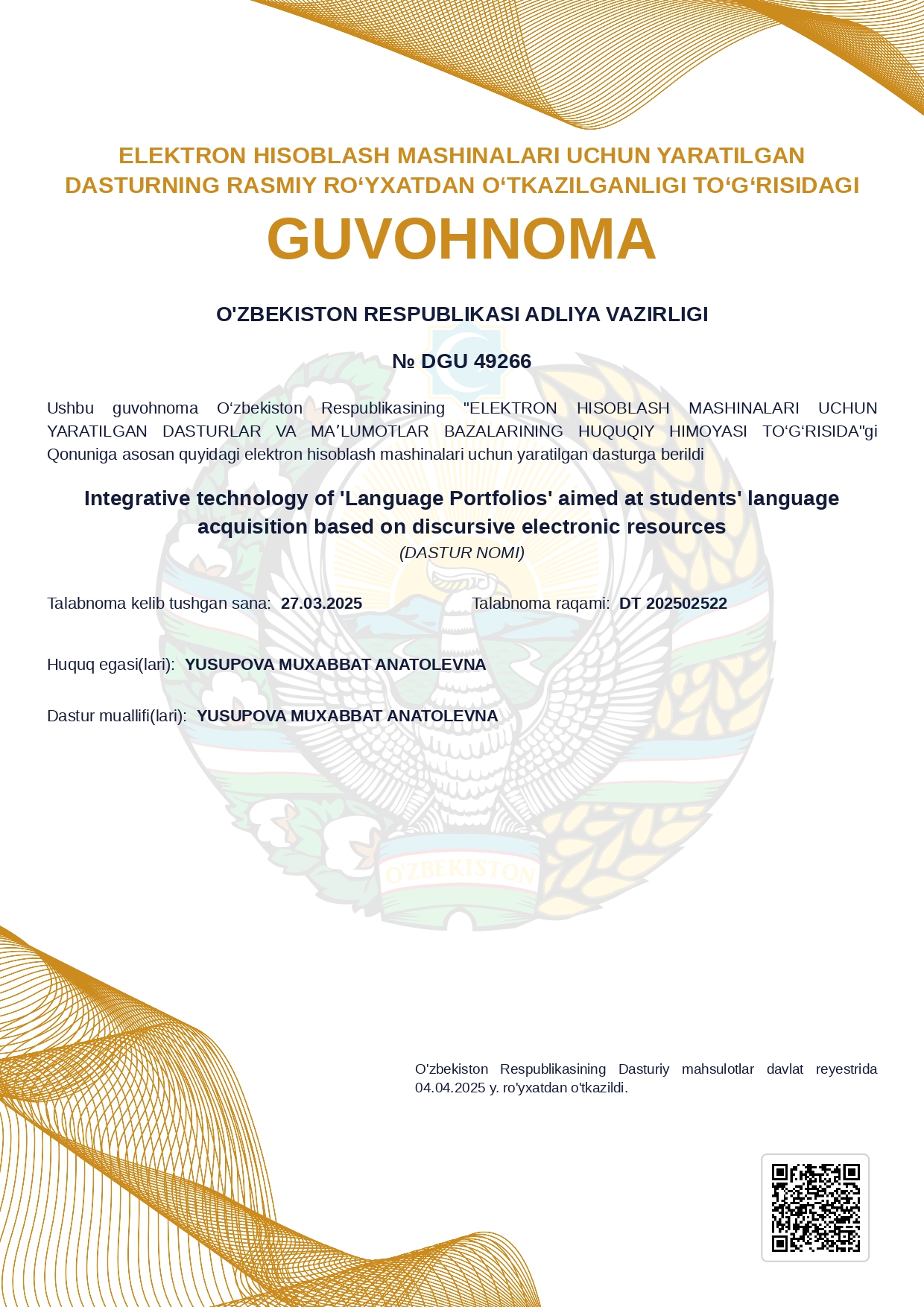
Certificate No. DGU 49266 — registered in the State Register of Software Products of the Republic of Uzbekistan on 04.04.2025.
IDWPL is meant for learners and teachers who find that language sticks better when it is tied to something real — who would rather work with a text than simply read one.